
A speeding driver triggered it. But the road itself turned one mistake into a mass-casualty fire. Here is what happened at Al-Warraq, and how the corridor can be redesigned so it never happens again.
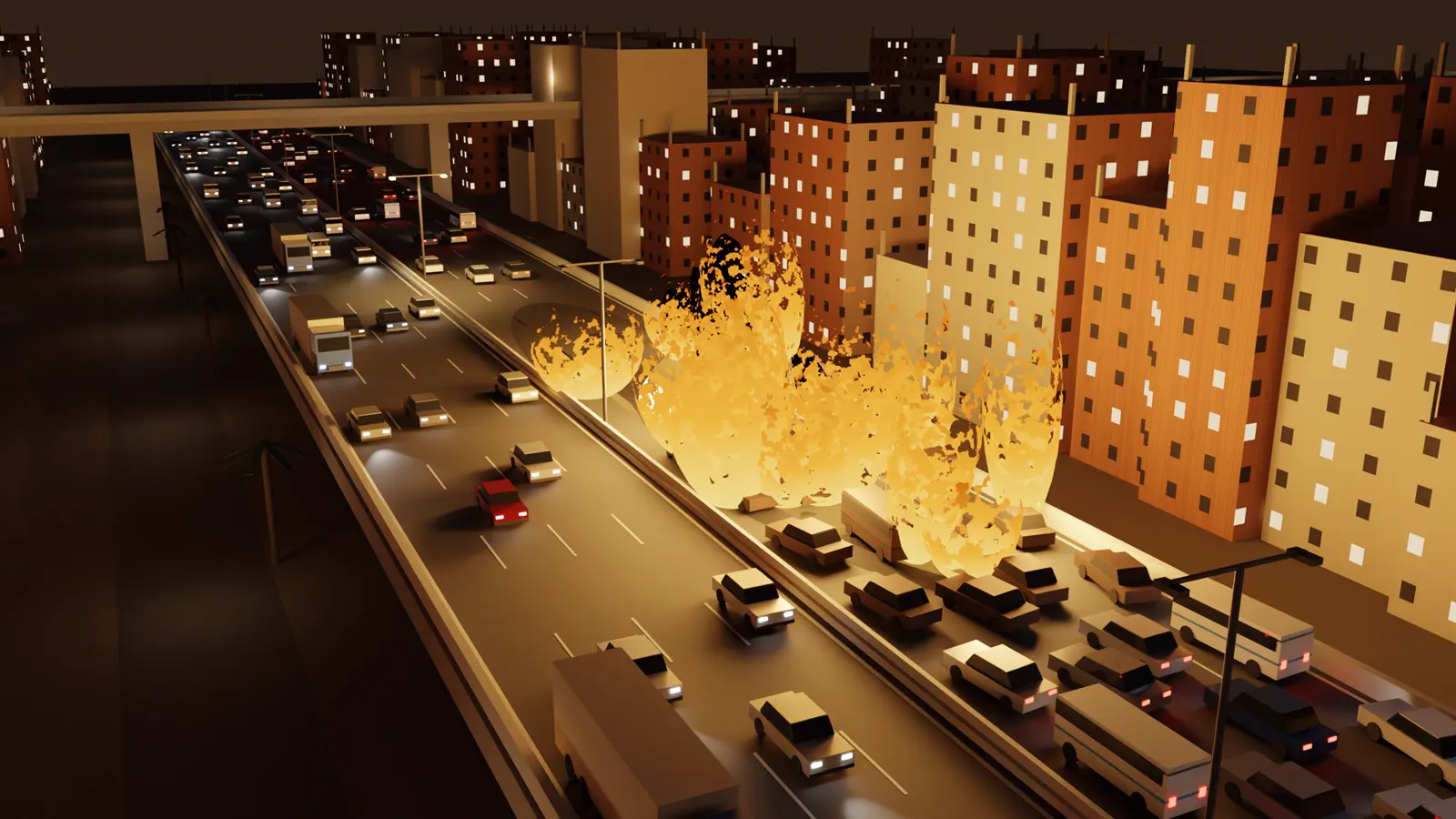
On Wednesday evening, a road tanker loaded with petroleum products overturned on the elevated Cairo Ring Road in Al-Warraq, Giza, above Tunnel 10. The spilled fuel ignited, and the fire spread through the traffic around it. The Ministry of Health put the final toll at 31 dead and 26 injured. Some 27 vehicles, including cars and motorcycles, were destroyed, and one report puts the tanker's load at 51,000 litres of petrol.
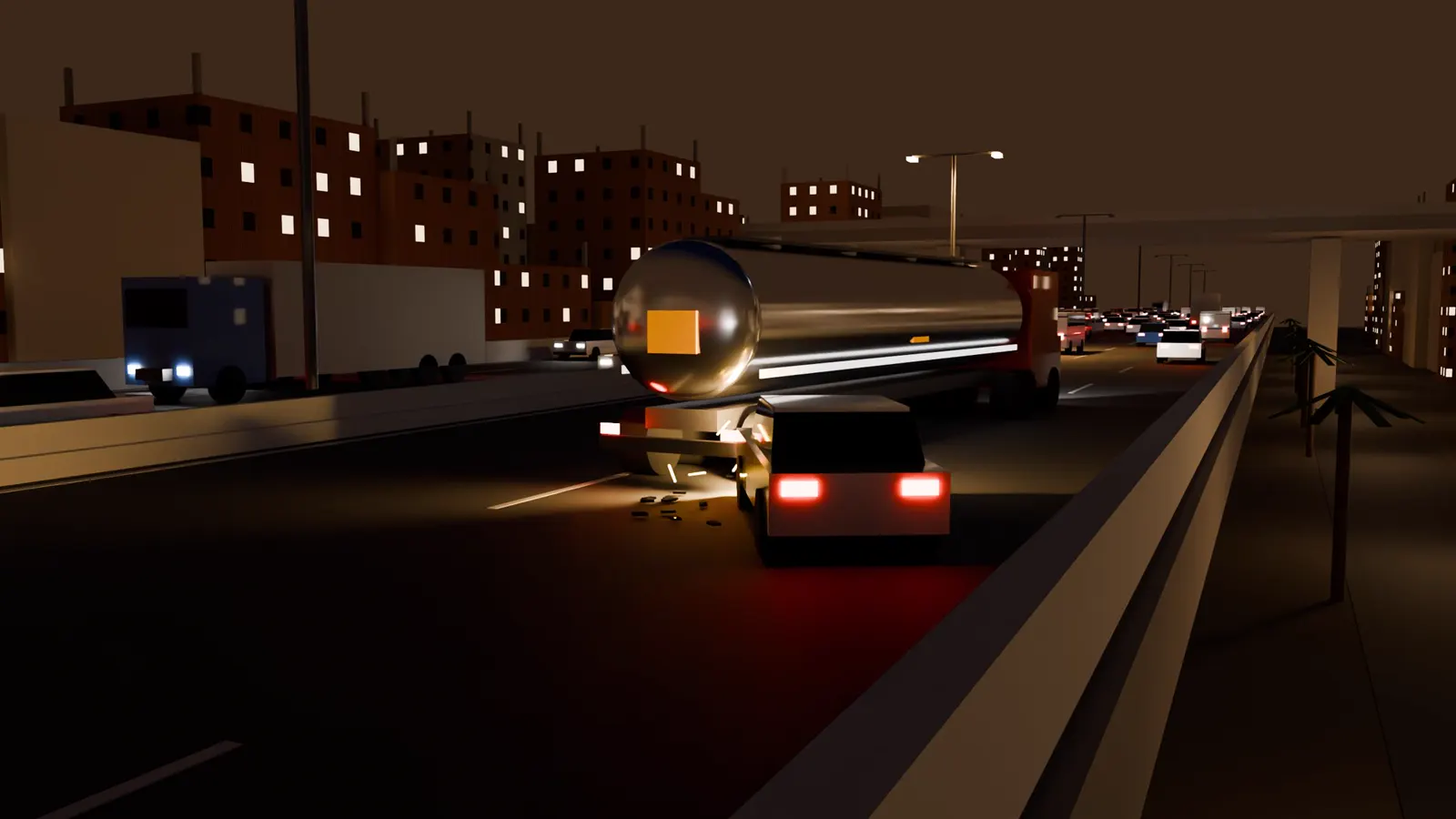
According to the prosecution, the trigger was a private car. Its driver, now under arrest, admitted travelling at about 110 km/h and changing lanes to overtake. While doing so, the front-left of his car struck the right side of the tanker's rear. He lost control. A tanker tyre then burst, and the tanker hit the concrete barrier, overturned and leaked petrol, which caught fire.
That driver's responsibility is real. But engineers have to ask a harder question: why could one driver's mistake kill 31 people? On a well-designed road, the same error should end with a damaged car and a tanker stopped on the shoulder.
The chain that turned an error into a disaster
Disasters like this are rarely caused by one failure. They come from a chain of weaknesses, each of which lets the situation get worse. On this corridor we count six links:
- Speed. At 110 km/h a car covers about 30 metres every second and needs roughly 215 metres to stop. Weaving into short gaps behind a slower tanker leaves well under two seconds to react.
- Mixed lanes. Heavy tankers share every lane with fast traffic, so cars overtake them on both sides. The reported impact, a car's front-left against a tanker's right-rear, is exactly the conflict this creates.
- Barriers built for cars. A loaded tanker's centre of gravity sits higher than a typical concrete barrier. Instead of holding the tanker, the barrier trips it into a rollover, which is what breaches tanks.
- Darkness. Patchy lighting and failed lamps leave dark gaps where a slow heavy vehicle is hard to judge in time.
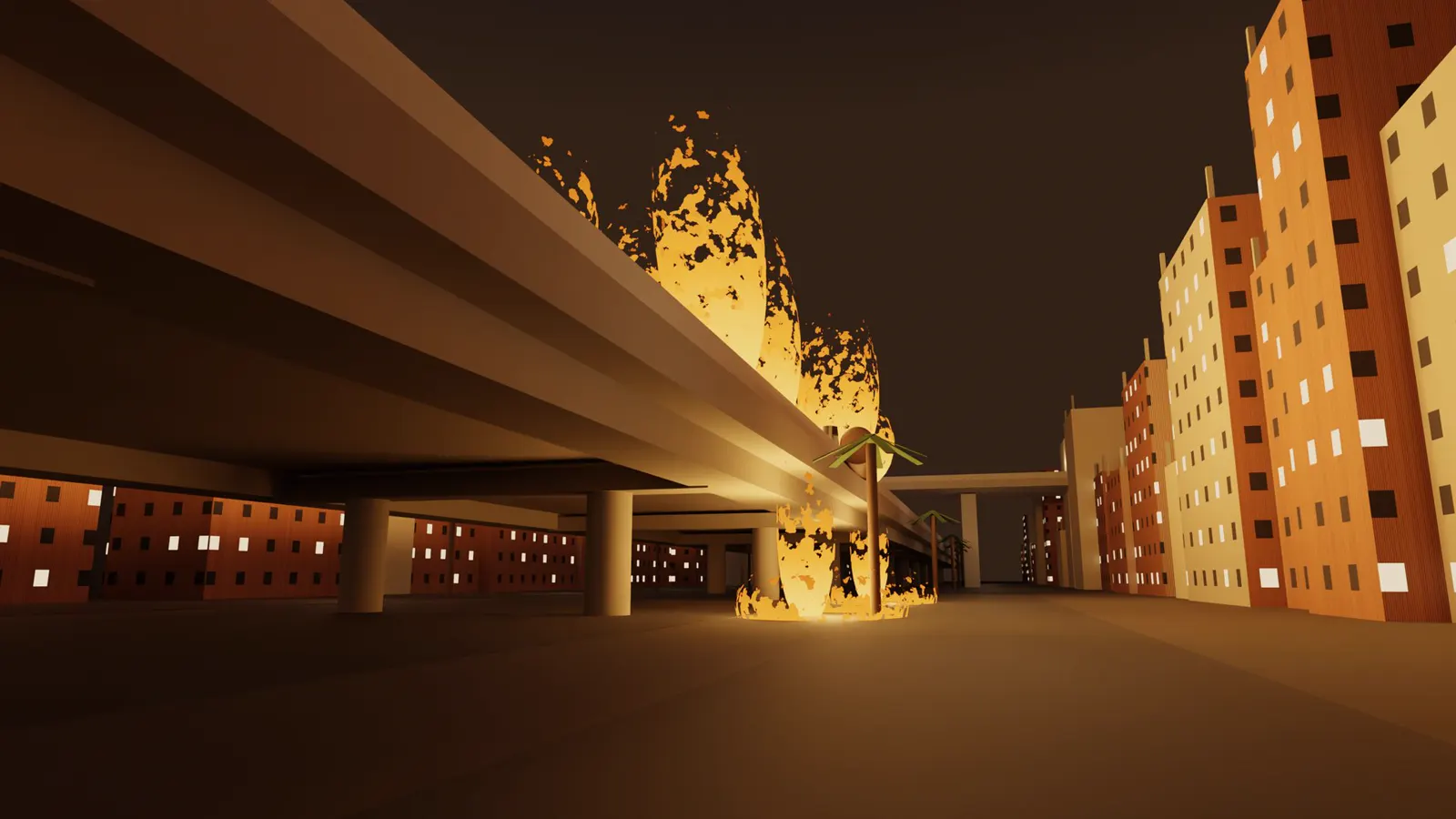
- Open drainage. On an elevated road, spilled fuel runs to the kerb and through deck drains, so burning fuel can fall onto the streets and homes below.
- No escape, slow access. There is no hard shoulder and no emergency crossover, so the cars behind the fire cannot turn back. Footage showed civilians helping victims before official responders arrived.
These are screening-level engineering estimates. They are not meant to be exact. They show the scale of the problem, and why it is a design problem rather than a matter of bad luck.
One question for the investigation
Egypt's Ministry of Interior bans trucks over 4 tonnes from the Ring Road between 6 am and midnight. A loaded petrol tanker was on the road on a Wednesday evening, inside that window. Whether it held an exemption or permit, and how that rule is enforced, should be a central part of the official inquiry.
“A disaster like this is not bad luck. It is designed in — and it can be designed out.”
Same traffic, same driver, different road
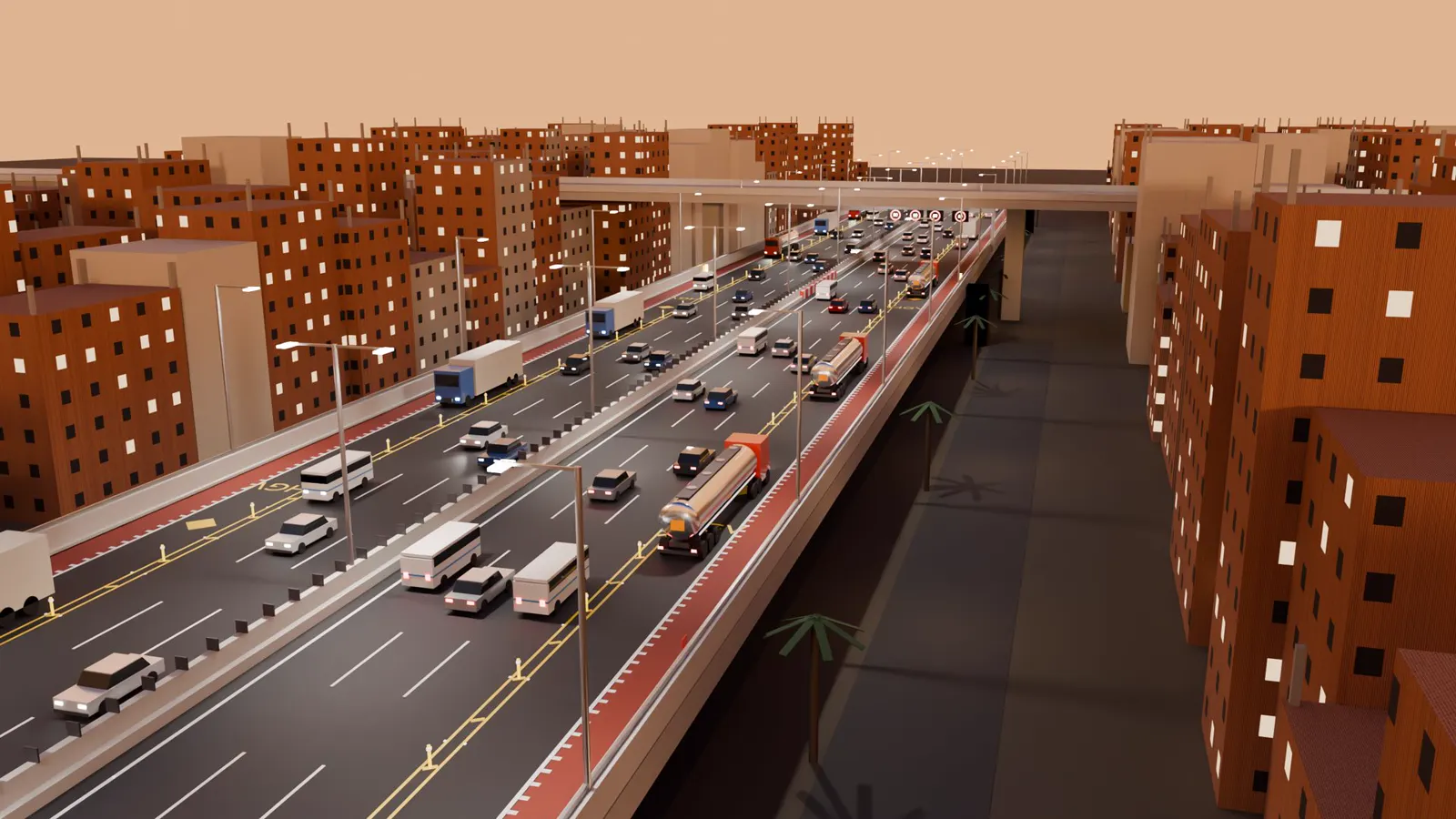
In our simulation we replayed the same traffic and the same driver behaviour on a redesigned corridor. The tanker travels in its own lane, separated by a buffer and yellow delineators, so the speeding car cannot cut into it. Average-speed cameras hold cars at 80 km/h, which removes almost half the crash energy. When we forced a tyre failure anyway, stability control brought the tanker to a safe stop on a three-metre emergency shoulder. Traffic kept moving, and there was no spill and no fire.
Drag the slider to compare the corridor today with the redesign.
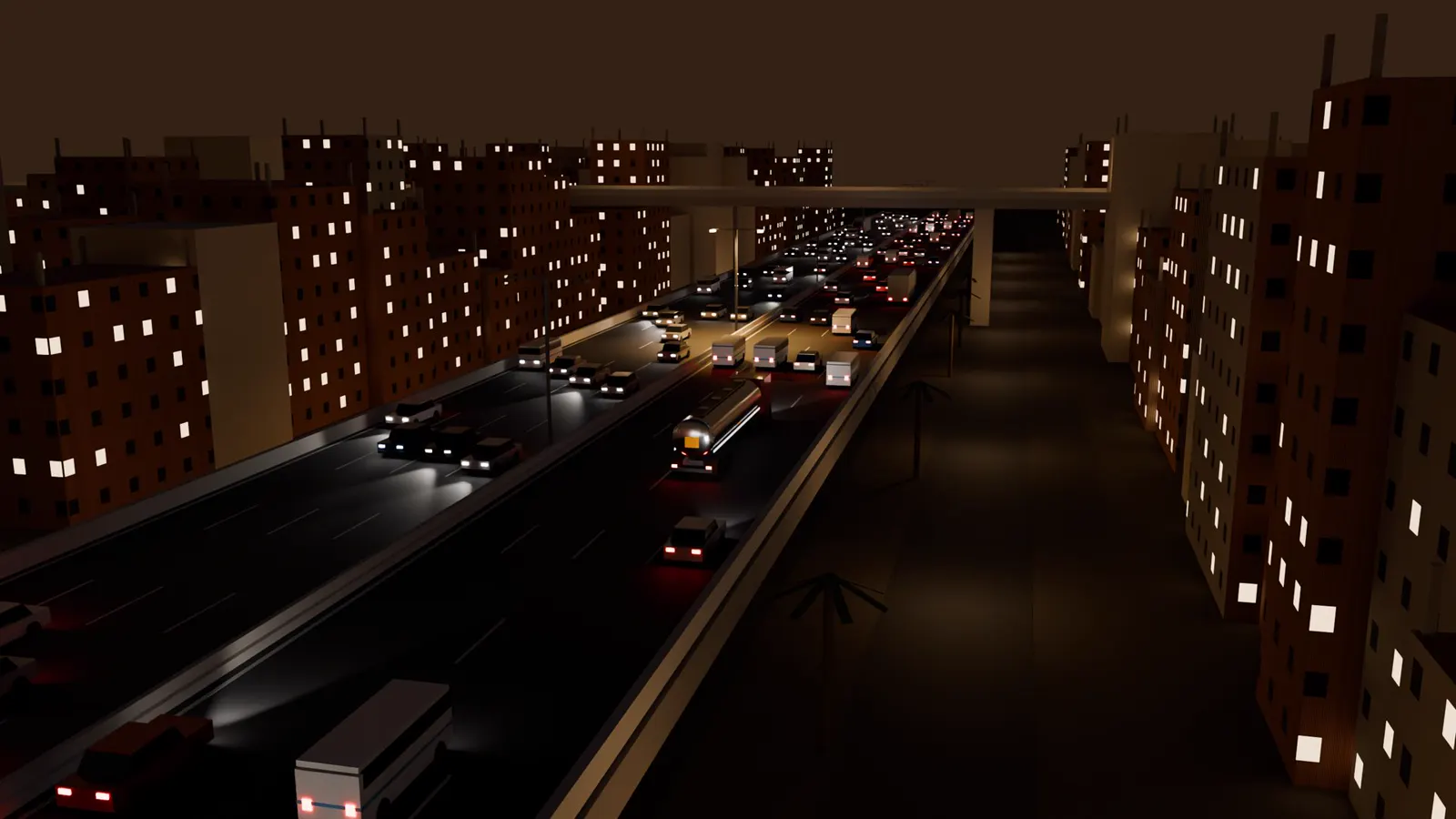
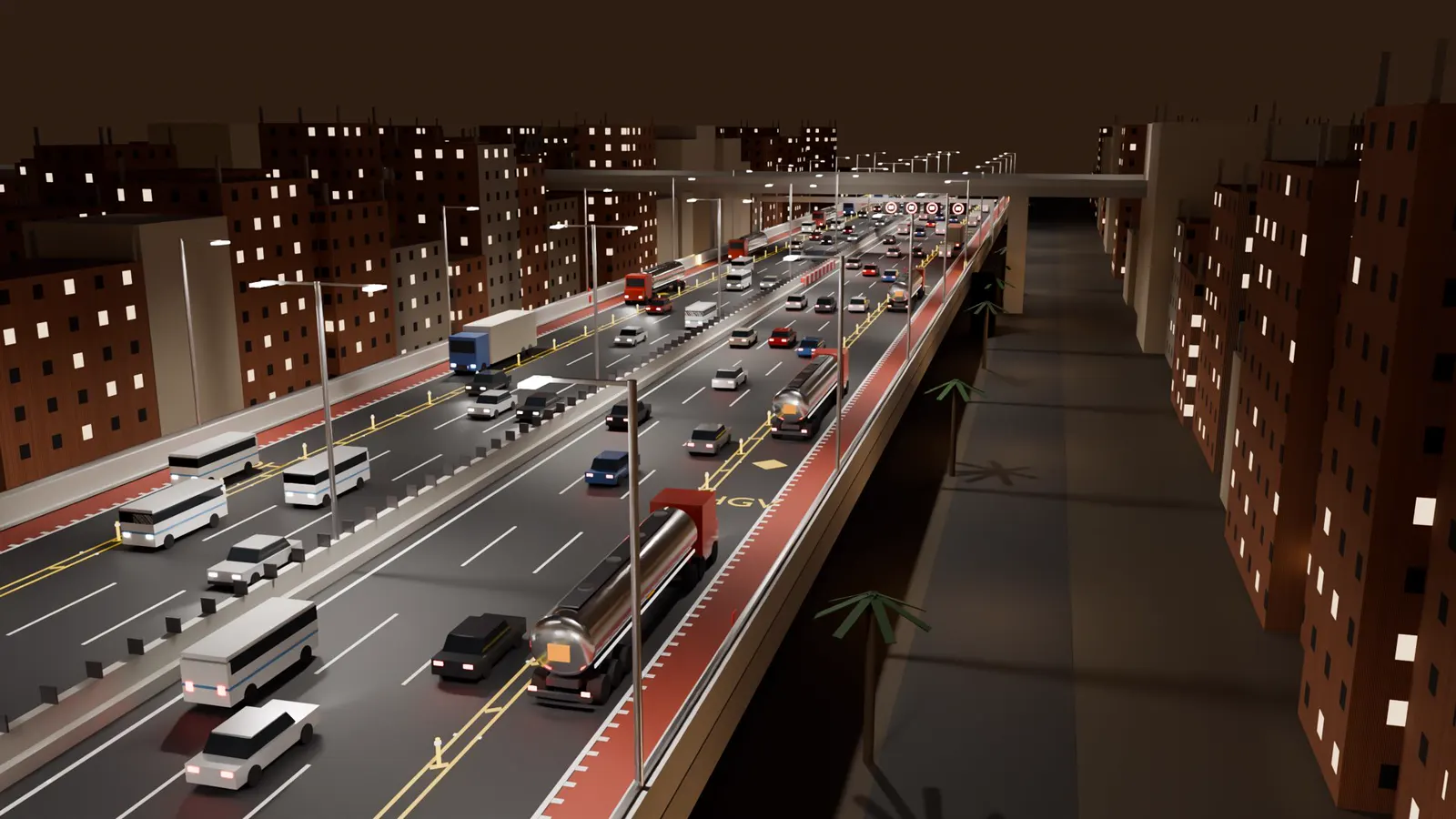
Left: the corridor as it is today (illustrative). Right: the PERFECTRA GROUP redesign, with continuous LED lighting, a dedicated heavy-vehicle lane and an emergency shoulder.
The redesign, in eight measures
1. Keep tankers off peak roads
Hazardous loads only in a night window (for example 00:00–05:00), with e-permits and GPS tracking. Transit tankers use the Regional Ring Road.
2. A lane of their own
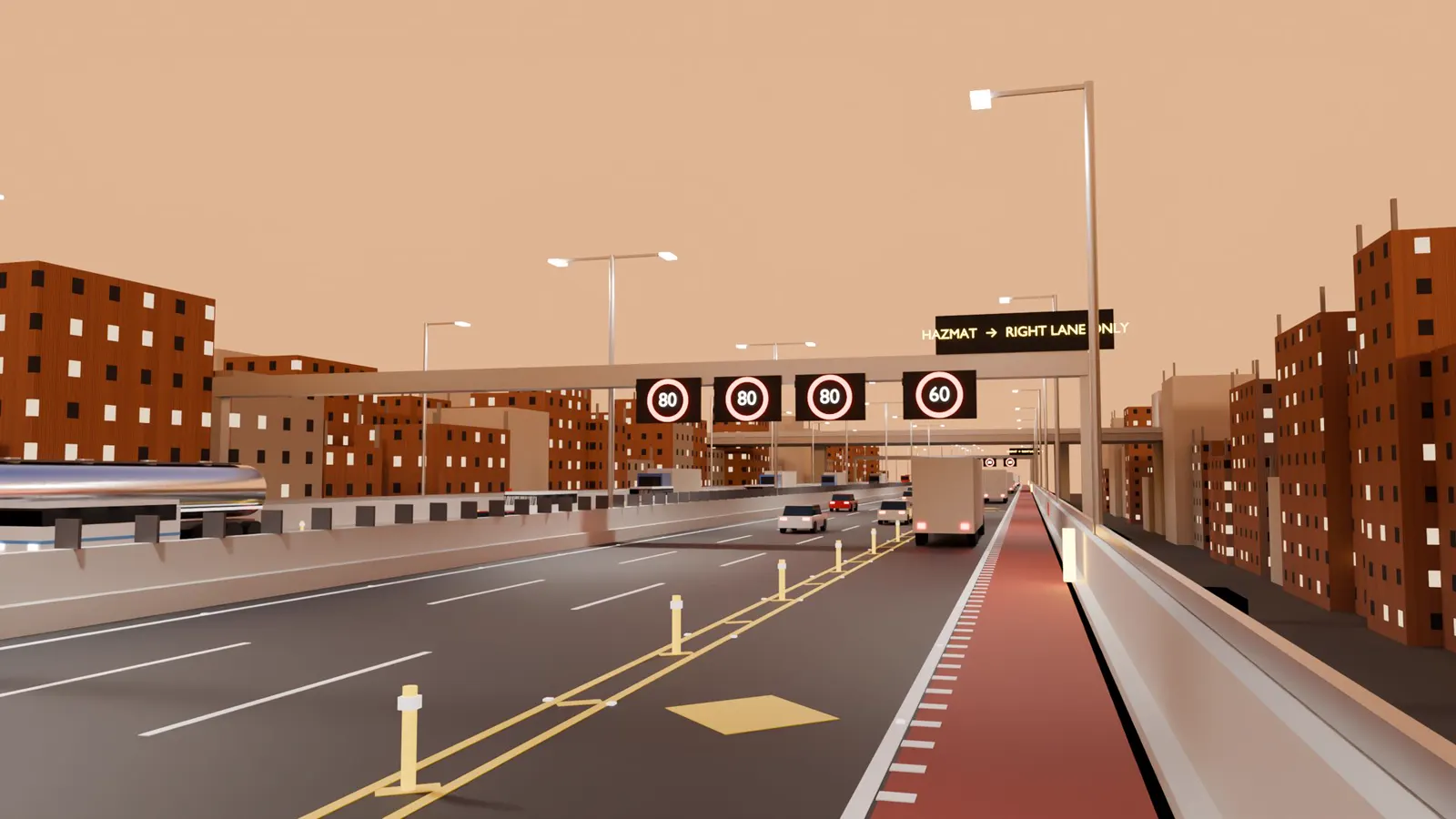
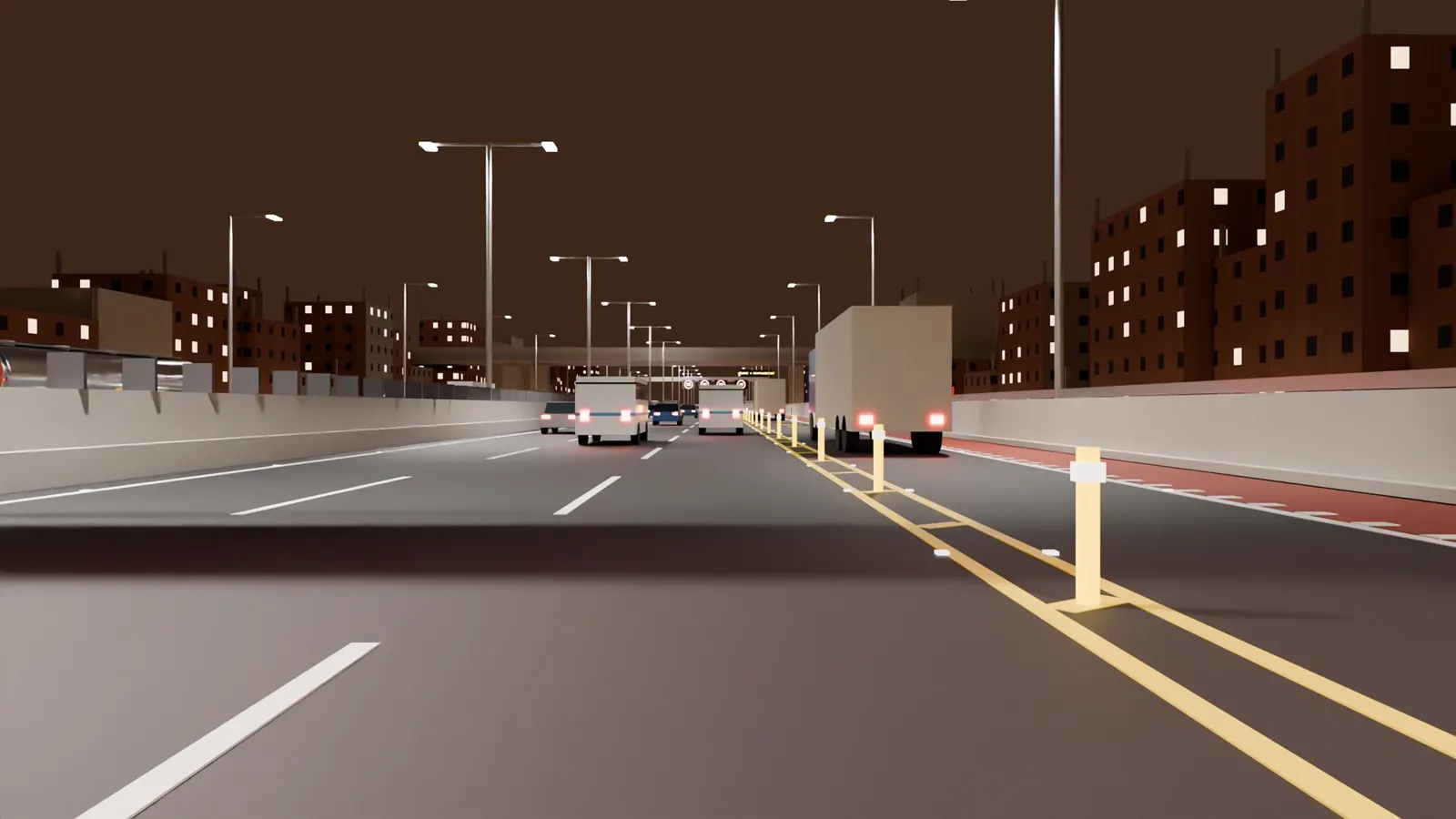
A 3.75 m heavy-vehicle and hazmat lane on the right, separated by a buffer, double yellow lines and flexible posts every 8 m.
3. Speed you can't cheat
80 km/h for cars and 60 km/h for trucks, enforced by average-speed cameras over several kilometres rather than single radar points.
4. Barriers that hold a tanker
Very-high-containment parapets and median (MASH TL-6 / EN 1317 H4b class), designed to redirect a loaded tanker rather than trip it.
5. Light without gaps
Continuous white LED lighting to international road-lighting classes, with a monitoring system that reports any failed lamp within minutes.
6. Room to escape
A 3.0 m emergency shoulder, emergency crossovers every 1–2 km, and stairs and SOS phones about every 500 m.
7. Catch the fuel, not the street
Continuous slot drains with flame traps, closed pipes inside the piers, sealed spill interceptors, and fire-water outlets every 90 m.
8. Safer tankers and faster response
Roll-stability control, tyre-pressure monitoring and speed limiters on every tanker. Automatic incident detection and foam tenders stationed along the corridor.
Designing for how people really drive
Codes describe an ideal driver. Cairo's roads are used by real people under real pressure: long commutes, microbuses stopping wherever passengers wait, and tanker drivers paid per trip who run at night to beat time bans. Good design treats this behaviour as an input, not an excuse. Where we cannot rely on compliance, the road should make the safe choice the only practical one:
- Physical separation instead of paint alone. Posts and buffers rather than lines that can be ignored.
- Average-speed enforcement. It changes behaviour over distance instead of a brief brake at a camera.
- Off-line bus bays at the ramps. Microbuses then have a legal place to stop instead of a live lane.
- A road that forgives mistakes. When someone gets it wrong, the outcome is survivable.
What can be done in the next 30 days
Some measures need structural works and years of construction. Others cost little and could protect lives within weeks:
| Action | Why it matters |
|---|---|
| Enforce the existing ban on tankers in daytime and evening hours, with cameras at entry ramps | Removes the most dangerous mix of traffic immediately |
| Replace every failed lamp and restore lane markings and road studs | Eliminates dark gaps at very low cost |
| Install temporary variable-speed signs and mobile average-speed enforcement | Brings speeds and crash energy down |
| Reallocate the existing lanes to create a delineated heavy-vehicle lane | Separates tankers from weaving traffic without widening |
| Commission a full road safety audit and an inter-agency hazmat incident plan | Finds the next hotspot before it becomes the next tragedy |
Every factor that made this fire so deadly can be engineered out. The measures above rest on proven international standards and on the Safe System approach promoted by the World Health Organization. That approach accepts that people will make mistakes, and designs roads, vehicles and speeds so that a mistake does not cost a life.
Request the full technical report
Our full report covers the detailed reconstruction, failure-scenario simulations, a codes-and-standards gap analysis, 2D engineering drawings, 3D renders and a phased implementation programme. PERFECTRA GROUP is ready to support the competent authorities with surveys, design and implementation.
Contact sales@perfectragroup.comSources
- Arab News — Driver arrested after fuel tanker crash kills 31 on Cairo's Ring Road
- The New Arab — Shock and anger in Egypt after tanker explosion kills 31 people
- NBC News — Fuel tanker crash ignites a massive fire on a highway surrounding Cairo
- Gulf News — Cairo Ring Road fuel tanker crash
- Maspero — Ministry of Health final toll (Arabic)
- Cairo Mubasher — Investigation details (Arabic)
- Elaph — Reported tanker load and location (Arabic)
- Hatla2ee — Ministry of Interior Ring Road truck ban (Arabic)
PERFECTRA GROUP · Engineering – Technology – Environment · 131 Continental Dr, Newark, DE 19713, United States · sales@perfectragroup.com